

Zo kun jij je pupilafstand meten!
What is Pupil Distance?
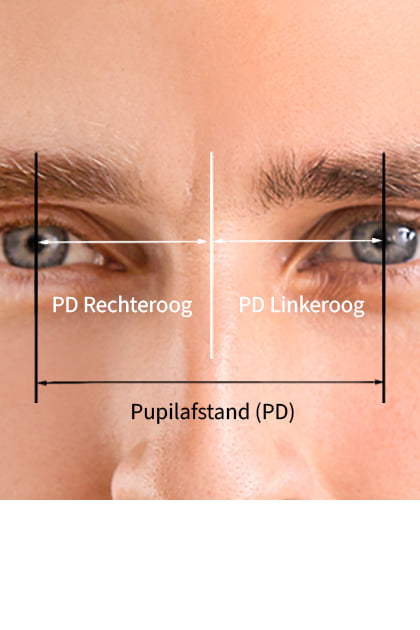
Pupil distance, or PD, measures the space between the center of one pupil and the center of the other, expressed in millimeters. Typical measurements range between 54-74mm and vary based on individual facial structure.
Why Pupil Distance Matters
Accurate PD measurement ensures optical centers of lenses align precisely with visual axes, providing clear, undistorted vision. Incorrect PD can cause visual disturbances, double vision, eye strain, and fatigue. Proper measurement is particularly critical for multifocal lenses, which offer multiple viewing zones in one lens.
Measurement Methods
The article describes five approaches:
Professional measurement - Opticians, optometrists, or eye doctors using specialized equipment (most accurate)
Self-measurement with ruler and mirror - Using a millimeter-scaled ruler against a clear mirror
Measurement with assistance - Having someone else perform the measurement for better accuracy
Smartphone apps - Using camera-based applications with algorithms to calculate PD
PD measuring cards - Special cards with printed scales provided by opticians
Lensplaza's Online Tool
Lensplaza offers an innovative method: uploading a facial photo for automated PD measurement using advanced image analysis technology. This integrates directly into eyeglass configuration.
Measurement Tips
Use a ruler with clear millimeter markings
Maintain proper head position, looking straight ahead
Ensure adequate lighting
Consider asking for assistance when measuring alone
FAQ
What are pupils and their function?
The pupil is the dark opening in the center of the iris that controls how much light enters the eye.
Why is PD important for eyeglass fitting?
PD ensures proper lens alignment with your visual axes for optimal vision correction.
Does PD remain constant?
PD generally remains stable in adults but can change slightly over time.
Does PD vary between eyes?
Yes, most people have slightly different distances from each pupil to the center of the nose (monocular PD).